5G Standards and Protocol Reference


1- Purpose
This article answers the following questions:
- What are the main 5G standards organizations?
- What is the vision for 5G?
- What is the progress of 5G standards formulation?
2- Overview
5G has become one of the most widely discussed topics across both media coverage and everyday conversation. To build a clear and grounded understanding of this transformative technology, this document begins at the foundation — the standards organizations that define what 5G actually is and how it works.
3- Standards Organizations
5G: The foundation of next-generation connectivity
5G — short for 5th Generation Mobile Network — is more formally known as New Radio (NR), and carries the official ITU designation IMT-2020. That name signals both scope and timing: International Mobile Telecommunications, built for 2020 and the decades that follow.
Two organizations govern how 5G becomes reality.
The International Telecommunication Union (ITU) establishes the vision and defining performance targets, spectrum requirements, and use-case mandates that 5G must satisfy. Think of the ITU as setting the bar. Once standards are submitted, it performs the final evaluation to confirm compliance.
The 3rd Generation Partnership Project (3GPP) does the heavy engineering. Every protocol, radio interface, and network architecture specification that makes 5G work in the real world originates from 3GPP. Where the ITU defines what 5G must achieve, 3GPP defines how.
Together, these two bodies underpin the entire wireless ecosystem, from the chipsets powering mobile devices to the infrastructure connecting billions of users worldwide.
3.1 ITU
Founded in 1865 and headquartered in Geneva, Switzerland, the ITU is first one of the 15 United Nations specialized agencies and is mainly responsible for information and communication technology (ICT). We benefit from the work of the ITU in our daily life, such as making phone calls, surfing the Internet, or sending e-mails.

The ITU consists of three Sectors: ITU Radiocommunication Sector (ITU-R), ITU Telecommunication Standardization Sector (ITU-T), and ITU Telecommunication Development Sector (ITU-D), with multiple research work groups (WGs) in each Sector. 5G standardization is mainly carried out by the Working Party 5D (WP 5D) of ITU-R.
During the formulation of 5G standards, the ITU is mainly responsible for research in the early stage of standardization and continuously promotes the consensus of global 5G standards. In September 2015, the ITU officially named 5G "IMT-2020", which is consistent with the official names of 3G (IMT-2000) and 4G (IMT-Advanced). The ITU also finalized the official logo of 5G.
Figure 3-2 5G official logo

3.2 3GPP
The 3GPP established in December 1998 was initially aimed to formulate and implement global 3G mobile communications system specifications within the scope of the ITU's IMT-2000, hence the name 3rd Generation Partnership Project.

Currently, the seven 3GPP organizational partners are from China, Europe, the US, Japan, South Korea, and India, including:
- China Communications Standards Association (CCSA)
- European Telecommunications Standards Institute (ETSI)
- North America's Alliance for Telecommunications Industry Solutions (ATIS)
- Japan's Association of Radio Industries and Businesses (ARIB)
- Japan's Telecommunication Technology Committee (TTC)
- South Korea's Telecommunications Technology Association (TTA)
- Telecommunications Standards Development Society, India (TSDSI)
Figure 3-4 3GPP organizational partners

3GPP is essentially a global alliance of the wireless communications industry. It aims to formulate more detailed technical specifications and standards based on the requirements proposed by ITU to unify the specifications of the wireless communications industry.
In the 3GPP organizational structure, the Project Coordination Group (PCG) is responsible for overall coordination, such as overseeing the time frame and work assignment of 3GPP organizations, while the Technical Specification Groups (TSGs) dominate technical work.
- TSG radio access network (TSG-RAN): is responsible for the functions, requirements, and interfaces associated with the radio access network.
- TSG Service and System Aspects (TSG SA): undertakes system and service work.
- TSG Core and Terminals (TSG CT): encompasses work for core networks and terminals.
Each TSG is further divided into multiple WGs, each WG handling specific tasks.
Table 3-1 lists the latest organizational structure of 3GPP. There are 15 WGs for specific standard formulation and one ITU-specific WG — RAN AH1 — for information transmission and sharing between the 3GPP and ITU.
Table 3-1 3GPP organizational structure
PCG Project Coordination Group | ||
TSG RAN Radio access network | TSG SA Service and system aspects | TSG CT Core networks and terminals |
RAN WG1 Radio layer 1 specifications | SA WG1 Services | CT WG1 Specifications for interworking between terminals and the core network |
RAN WG2 Radio layer 2/layer 3 specifications | SA WG2 System architecture and services | CT WG3 Interworking with external networks |
RAN WG3 RAN architecture and related network interface specifications | SA WG3 Security and privacy | CT WG4 Core network protocols |
RAN WG4 Radio performance and protocols | SA WG4 Codec | CT WG6 Smart card applications |
RAN WG5 Mobile terminal conformance tests | SA WG5 Telecom management | |
SA WG6 Key applications | ||
RAN AH1 Specific group for coordination with the ITU | ||
The 3GPP organizational structure does not always remain unchanged, but will be adjusted with the development of technologies. The most recent adjustment was in July 2020. At the RAN#88e plenary meeting, 3GPP announced the closure of WG6 under TSG RAN, which was responsible for GERAN and UTRAN radio and protocol work, that is, 2G and 3G protocol specifications.
3GPP specifications are managed based on releases, such as R15 and R16. It takes about 15 to 21 months to formulate and release (or freeze) a version. The first version released by 3GPP is R1999, which is the first 3G standard. 1999 refers to the year 1999, and later versions are no longer named by year. In 2008, 3GPP released the first LTE standard — R8. The first 5G standard, R15, was released in 2017.
Figure 3-5 3GPP release history

4- 5G Vision
The development of mobile Internet in 4G has profoundly changed people's lives, but people's pursuit of higher-performance mobile communications has never stopped. 5G will penetrate into various fields of the society in the future and build a user-centric comprehensive information ecosystem.
Since 2012, the ITU has organized the global industry to start research on 5G standardization in the early stage. In September 2015, the ITU defined the vision and application scenarios of 5G and proposed its key capability indicators.
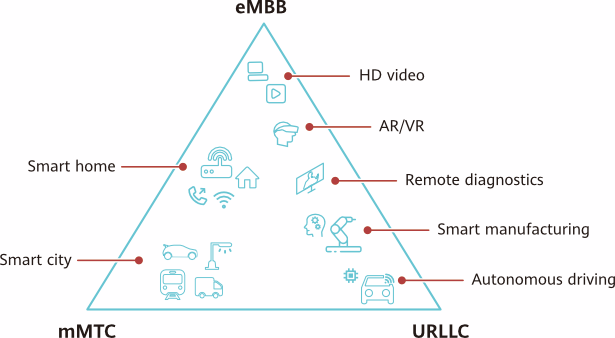
According to ITU-proposed vision white paper, 5G has three typical application scenarios: enhanced Mobile Broadband (eMBB), ultra-reliable low-latency communication (URLLC), and Massive Machine-Type Communications (mMTC), as shown in Figure 4-1.
- eMBB is a further evolution of current mobile broadband services and mainly serves the consumer Internet. It supports higher network bandwidth and rate, and further larger data traffic and enhanced user experience.
- URLLC is a communication with an ultra-low latency and ultra-high reliability. It has extremely strict requirements on performance such as throughput, latency, and reliability. It can be applied in fields such as wireless control of industrial manufacturing or production processes, remote surgery, power distribution automation of smart grids, and transportation security.
- mMTC refers to a service that supports a large quantity of terminals. This scenario is most characterized by a large quantity of connected devices that usually transmit a relatively small amount of delay-insensitive data. The device cost needs to be reduced, and the battery endurance needs to be significantly prolonged.
Figure 4-1 Three 5G application scenarios
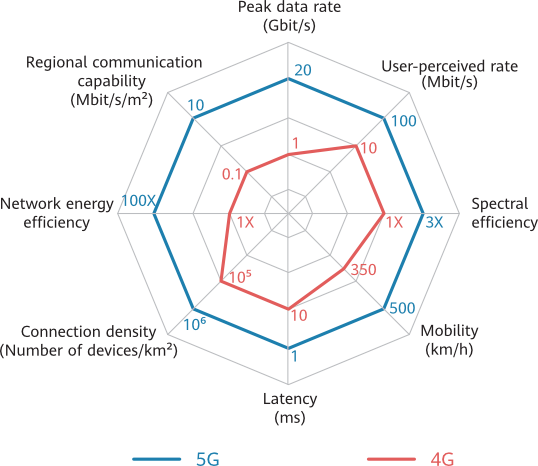
The ITU also defines 5G key capability indicators from eight aspects, as listed in Table 4-1. Figure 4-2 shows the comparison of these key indicators between 5G and 4G. This is the cobweb model that is familiar to the industry.
Table 4-1 5G key capability indicators
Indicator | Indicator Definition | ITU-required Value |
|---|---|---|
Peak data rate | Maximum transmission rate for a single user under ideal conditions | 20 Gbit/s |
User-perceived rate | Minimum transmission rate available to users in the actual network environment | 100 Mbit/s |
Latency | Duration from the time when a data packet is transmitted from the source node to the time when the data packet is correctly received by the destination node | 1 ms |
Mobility | Maximum relative moving speed of the sender and receiver when certain performance requirements are met | 500 km/h |
Connection density | Total number of online devices supported per unit area | 1 million/km2 |
Network energy efficiency | Number of bits that can be transmitted per joule of energy | 100 times of 4G |
Spectral efficiency | Traffic volume per cell or per unit area per unit of spectrum resources | 3 times of 4G |
Regional communication capability | Total traffic volume per unit area | 10 Mbit/s/m2 |
Figure 4-2 Comparison of key indicators between 5G and 4G
In addition to the preceding eight key indicators, the ITU proposes the following five performance indicators to ensure the flexibility, reliability, and security of 5G in different application scenarios:
- Spectrum and bandwidth flexibility: the flexibility of a system design in different application scenarios, especially the capability to operate in different frequency ranges, including a higher frequency and a wider channel bandwidth.
- Reliability: the ability to provide specific services with high availability.
- Recovery capability: the ability of a network to continue to operate properly when or after natural or man-made interference (such as a power failure of the main power supply) occurs.
- Security and privacy: Multiple fields are involved, for example, encryption and integrity protection of user data and signaling, protection of end users' privacy against unauthorized user tracing, and protection of networks against hacker attacks, fraud, DoS, and man-in-the-middle attacks.
- Operational life: operating time after each energy storage. This is especially important for machine-type devices that require extremely long battery life (for example, more than 10 years). Due to physical and economic factors, routine maintenance of such devices is a demanding task.
5-5G Standards Formulation Progress
The ITU defines the vision and requirements of 5G, but the specific standards research and formulation are implemented by the 3GPP.
At the RAN workshop on 5G held in Phoenix, USA, in September 2015, 3GPP proposed the standards research timeline for 5G, aiming to submit 5G technical standards within the time schedule planned by the ITU.
3GPP Release 15:
5G's first chapter began with 3GPP Release 15 (R15) — the foundational standard that defined the technical specifications for enhanced Mobile Broadband (eMBB). Rather than rolling out as a single monolithic spec, R15 was deliberately structured in two phases to give operators flexibility and speed their path to market.
The first phase addressed Non-Standalone (NSA) architecture, with its protocol standards frozen in December 2017. NSA was designed to be practical: it leverages 5G New Radio's superior transmission capabilities to boost the speed and capacity of existing 4G infrastructure, without replacing it. The tradeoff is intentional — NSA relies on the 4G core network, which means it can't fully unlock the new services that 5G is ultimately built to deliver.
The second phase brought Standalone (SA) architecture, finalized in June 2018. This is where 5G stands on its own as a complete, independent network with a native 5G core. SA marks the moment the 5G standard was officially complete and truly capable of supporting the full spectrum of next-generation services.
Together, these two phases gave the industry a pragmatic on-ramp: operators could deploy NSA quickly to deliver immediate performance gains, while building toward the full SA architecture that makes 5G's long-term promise real.
3GPP Release 16:
Release 15 was where it began. As the first standardized version of 5G, R15 laid the foundation by addressing enhanced Mobile Broadband (eMBB), delivering the raw speed and capacity that made 5G headlines. But R15 was a starting point, not a finish line. It established that 5G could work. What came next determined whether it would work for the world.
That's where Release 16 changed everything.
Building on R15's groundwork, R16 didn't just refine eMBB — it expanded 5G's ambitions entirely. It brought serious attention to the two application scenarios that R15 left incomplete: Ultra-Reliable Low-Latency Communications (URLLC), critical for industrial automation and mission-critical connectivity, and massive Machine-Type Communications (mMTC), the backbone of large-scale IoT deployments. Frozen in July 2020, R16 marked 5G's transformation from a consumer technology into a platform for entire industries.
R16 is, by every meaningful measure, the first complete version of 5G.
It's also practical in ways that matter. R16 addressed the real-world concerns of network operators and enterprises alike — optimizing for cost efficiency and energy consumption, not just peak performance. The result is a 5G ecosystem that's not only more capable, but more deployable, more sustainable, and more ready for the demands of vertical industries from manufacturing to healthcare to transportation.
R15 opened the door. R16 built what's behind it.
3GPP Release 17:
3GPP Release 17 & 18: Advancing Connectivity for the Intelligent Era
With Releases 15 and 16 frozen and commercially deployed, 3GPP wasted no time kicking off research for Release 17 (R17) in June 2019.
R17 marks a decisive step deeper into vertical industry transformation. Building on the foundation R16 established, it advances critical capabilities across massive MIMO and multi-antenna technologies, ultra-reliable low-latency communications (URLLC), Industrial IoT, device power efficiency, high-precision positioning, and Vehicle-to-Everything (V2X). But R17 doesn't stop at refinement it introduces a new layer of capability purpose-built for emerging real-world demands: enhanced coverage reach, native multicast and broadcast support, sidelink communication for mission-critical and commercial device-to-device use cases, and intelligent multi-SIM device optimization.
R17 was officially frozen in June 2022, laying a robust and future-ready platform for the innovations R18 continues to build upon.
3GPP Release 18:
R18 is a further evolution of 5G, that is, 5G-Advanced, also known as 5.5G. It will further improve and enrich 5G application scenarios and gradually expand to cross-industry fields. Typical application scenarios will be expanded from the original triangle to the hexagon, with three new scenarios added: Uplink Centric Broadband Communication (UCBC), Real-Time Broadband Communication (RTBC), and Harmonized Communication and Sensing (HCS), revealing the sprout of 5.5G/6G development. R18 will significantly improve eMBB performance, popularize new immersive services such as XR, meet the requirements of large-scale digitalization in the industry, achieve intelligent connection of everything, and enable 5G to generate greater social and economic values. R18 has been frozen in June 2024.
Table 5-1 Main content and freezing time of 5G protocols
Version | Main Content | Freezing Time |
|---|---|---|
R15 | NSA architecture eMBB Frame structure and numerology | December 2017 |
SA architecture URLLC | June 2018 | |
R16 | eMBB enhancement, URLLC enhancement, and mMTC New multiple access and self-backhaul D2D, V2X, and unlicensed spectrum Energy efficiency and satellite access | July 2020 |
R17 | MIMO enhancement, industrial Internet, terminal energy saving, and positioning Coverage enhancement, multicast, broadcast, direct device-to-device communication oriented to emergency communications and commercial applications, and multi-SIM terminal optimization | June 2022 |
R18 | Added three application scenarios (UCBC, RTBC, and HCS) | June 2024 |
6 Overview of 5G Protocols
Introduction to 3GPP Specifications
The 3GPP specifications formulation process can be divided into two phases: Study Item (SI) and Work Item (WI). The former completes the feasibility study of the project, with the output being Technical Report (TR), while the latter completes the writing of technical specifications, with the output being Technical Specification (TS). The TR provides the background and significance of standards formulation, and the TS provides detailed technical specifications.
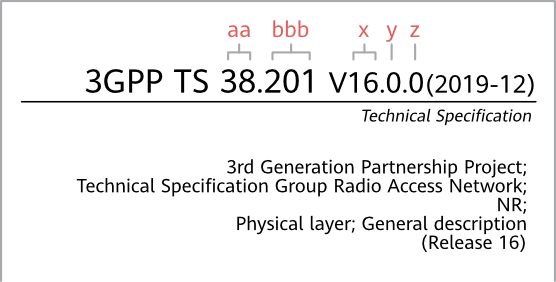
3GPP specifications are numbered in the following format:
- 3GPP TR aa.bbb (technical report)
- 3GPP TS aa.bbb (technical specifications)
aa is the serial number, and bbb is the tail number in the series. For example, 5G protocol 38.211 indicates the 211 protocol in the 38 series.
In addition to the serial number and tail number, a complete technical specification name must contain the version number, that is, x.y.z, where:
- x is the major field, which corresponds to the release version.
- y is the technical field. The value of this field is incremented when a technical change is made to a specification.
- z is the editorial field. The value of this field is incremented each time a non-technical change (such as editorial change) is made to a specification.
Their relationships are as follows: y is reset to zero every time x is incremented, and z is reset to zero every time y is incremented.
The following figure shows an example of a specification. It is the 201 protocol in the 38 series. The specific version number is V16.0.0, corresponding to R16 and indicating that no technical or non-technical changes have been made to this document in R16.
Main 5G Protocols
The 5G system mainly consists of the 5G access network (NG-RAN) and 5G core network (5GC). The protocols related to the NG-RAN are mainly in the 38 series, and those related to the 5GC are distributed in different series based on functions and services, for example, the 29 series for Service Based Architecture (SBA), 28 series for network slice management, 26 series for such applications as V2X/VR/AR/network automation, and 32 series for 5G charging.
This document describes the protocols related to the NG-RAN, that is, the 38 series. The 38.1xx series are RF specifications, 38.2xx series are air-interface physical-layer specifications, 38.3xx series are air-interface higher-layer specifications, 38.4xx series are NE interface specifications, and 38.5xx series are terminal conformance specifications. These specifications are in the charge of different WGs under the TSG RAN, as listed in Table 6-1.
Table 6-1 Main contents of 38 series protocols and corresponding WGs under the TSG RAN
Protocol Series | Content | WGs Under the TSG RAN |
|---|---|---|
38.1xx series | RF specifications | WG4 |
38.2xx series | Air-interface physical-layer specifications | WG1 |
38.3xx series | Air-interface higher-layer specifications | WG2 |
38.4xx series | NE interface specifications | WG3 |
38.5xx series | Terminal conformance specifications | WG5 |
Table 6-2 to Table 6-6 list the numbers and main contents of related protocols.
Table 6-2 38.1xx series: RF specifications
Protocol Number | Protocol Name | Protocol Overview |
|---|---|---|
TS 38.101-1 | User Equipment (UE) radio transmission and reception; Part 1: Range 1 Standalone | RF requirements for the transmitter and receiver of the terminal equipment related to the FR1 frequency bands |
TS 38.101-2 | User Equipment (UE) radio transmission and reception; Part 2: Range 2 Standalone | RF requirements for the transmitter and receiver of the terminal equipment related to the FR2 frequency bands |
TS 38.101-3 | User Equipment (UE) radio transmission and reception; Part 3: Range 1 and Range 2 Interworking operation with other radios | RF module requirements of terminals related to interoperability between FR1 and FR2 and RF specifications of NSA-related EN-DC terminals |
TS 38.101-4 | User Equipment (UE) radio transmission and reception; Part 4: Performance requirements | Baseband demodulation performance requirements of the equipment |
TS 38.104 | Base Station (BS) radio transmission and reception | RF requirements for the transmitter and receiver of the base station, including FR1 and FR2 frequency bands |
Table 6-3 38.2xx series: air-interface physical-layer specifications
Protocol Number | Protocol Name | Protocol Overview |
|---|---|---|
TS 38.201 | Physical Layer; General description | Overview of the physical layer, including positions and functions of the physical layer in the entire protocol structure, and the main contents and relationships of the physical layer specifications |
TS 38.202 | Services provided by the physical layer | Services provided by the physical layer, mainly including services and functions, physical layer model of UEs, concurrent transmission of a physical channel and an SRS, physical layer measurement |
TS 38.211 | Physical channel and modulation | Generation and modulation methods of physical layer signals, including the frame structure, definition and structure of physical resources, modulation scheme, sequence generation, generation method of physical signals, definition and structure of uplink and downlink physical channels and signals, and definition and structure of reference symbols |
TS 38.212 | Multiplexing and channel coding | Contents of the transport channel and control channel data, mainly covering the channel coding scheme, processing of the transport channel and control channel, and format of the downlink control information |
TS 38.213 | Physical layer procedures for control | Features of physical-layer procedures for control, mainly covering synchronization procedures (including cell search and scheduled synchronization), radio link monitoring and link recovery procedures, power control procedures, random access procedures, reception and transmission of control channels on the UE side, common signaling, and partial bandwidth (BWP) operation |
TS 38.214 | Physical layer procedures for data | Features of physical layer procedures for data, mainly covering procedures related to the physical downlink shared channel (PDSCH) and procedures related to the physical uplink shared channel (PUSCH) |
Table 6-4 38.3xx series: air-interface higher-layer specifications
Protocol Number | Protocol Name | Protocol Overview |
|---|---|---|
TS 38.300 | Overall Description | Overall descriptions the 5G wireless interface protocol framework, mainly covering the wireless network architecture, protocol architecture, function division of each function entity, wireless interface protocol stack, physical-layer framework description, air-interface higher-layer protocol architecture description, mobility and state transition, scheduling mechanism, energy saving mechanism, QoS, security, and UE capability, as well as contents related to URLLC, IMS voice, network slicing, public warning system, and emergency services |
TS 38.304 | User Equipment (UE) procedures in Idle mode and RRC Inactive state | UE procedures in idle mode and RRC_INACTIVE state |
TS 38.305 | Stage 2 functional specification of User Equipment (UE) positioning in NG-RAN | UE positioning functions, mainly covering the UE positioning framework, positioning-related signaling and interface protocols, and main positioning procedures in the 5G system |
TS 38.306 | User Equipment (UE) radio access capabilities | Radio access capabilities of UEs, including definitions of UE capability parameters and descriptions of optional features without capability indication and conditional optional features |
TS 38.321 | Medium Access Control (MAC) protocol specification | Mainly descriptions of the MAC layer, including the MAC layer framework, channel structure and mapping, MAC entity functions, MAC procedures, BWP-related operations, MAC PDU formats, and parameter definitions |
TS 38.322 | Radio Link Control (RLC) protocol specification | Mainly descriptions of the RLC layer, including the RLC layer framework, RLC entity functions, RLC procedures, RLC PDU formats, and parameter definitions |
TS 38.323 | Packet Data Convergence Protocol (PDCP) specification | Mainly descriptions of the PDCP layer, including the PDCP layer framework, PDCP structure and entity, PDCP processing procedures, PDCP PDU formats, and parameter definitions |
TS 38.331 | Radio Resource Control (RRC) protocol specification | Mainly descriptions of the RRC layer, including the RRC layer framework, RRC-provided services for the upper and lower layers, RRC processing procedures, system information definitions, connection control, bearer management, mobility, RRC measurement, RRC messages and parameter definitions, and definition of RRC messages transmitted between network interfaces |
TS 37.324 | Service Data Adaptation Protocol (SDAP) specification | Mainly descriptions of the SDAP layer, including the SDAP layer framework, provided services, SDAP processing procedures, mapping between QoS and radio bearers, SDAP PDU formats, and parameter definitions |
Table 6-5 38.4xx series: NE interface specifications
Protocol Number | Protocol Name | Protocol Overview |
|---|---|---|
TS 38.401 | Architecture Description | Overall descriptions of 5G interfaces, including the overall architecture of the 5G RAN, logical division of signaling and data transmission, user-plane and control-plane protocols of main 5G RAN interfaces, and functions of each interface |
TS 38.410 | NG general aspects and principles | Overview of NG interfaces and division of NG interface specifications |
TS 38.411 | NG layer 1 | Physical layer functions of the NG interface |
TS 38.412 | NG signalling transport | Protocols and functions of the signaling bearer transport layer of the NG interface |
TS 38.413 | NG Application Protocol (NGAP) | A radio network layer protocol of the NG interface, which is the most important protocol of the NG interface, including signaling procedures related to the NG interface, NGAP functions, NGAP procedures, NGAP message definitions, and the like |
TS 38.414 | NG data transport | Protocols and functions of the user-plane data transmission layer of the NG interface |
TS 38.420 | Xn general aspects and principles | Overview of Xn interfaces and division of Xn interface specifications |
TS 38.421 | Xn layer 1 | Physical layer functions of the Xn interface |
TS 38.422 | Xn signalling transport | Protocols and functions of the signaling bearer transport layer of the Xn interface |
TS 38.423 | Xn application protocol (XnAP) | A radio network layer protocol of the Xn interface, which is the most important protocol of the Xn interface, including signaling procedures related to the Xn interface, XnAP functions, XnAP procedures, XnAP message definitions, and the like |
TS 38.424 | Xn data transport | Protocols and functions of the user-plane data transport layer of the Xn interface |
TS 38.425 | NR user plane protocol | User-plane functions and procedures, including the user-plane frame structure and information element (IE) definitions |
TS 38.455 | NR Positioning Protocol A (NRPPa) | Control-plane radio network layer signaling procedures between the NG-RAN node and the LMF node |
TS 38.460 | E1 general aspects and principles | Overview of E1 interfaces and division of E1 interface specifications |
TS 38.461 | E1 layer 1 | Physical layer functions of the E1 interface |
TS 38.462 | E1 signalling transport | Protocols and functions of the signaling bearer transport layer of the E1 interface |
TS 38.463 | E1 Application Protocol (E1AP) | A radio network layer protocol of the E1 interface, which is the most important protocol of the E1 interface, including signaling procedures related to the E1 interface, E1AP functions, E1AP procedures, E1AP message definitions, and the like |
TS 38.470 | F1 general aspects and principles | Overview of F1 interfaces and division of F1 interface specifications |
TS 38.471 | F1 layer 1 | Physical layer functions of the F1 interface |
TS 38.472 | F1 signalling transport | Protocols and functions of the signaling bearer transport layer of the F1 interface |
TS 38.473 | F1 application protocol (F1AP) | A radio network layer protocol of the F1 interface, which is the most important protocol of the F1 interface, including signaling procedures related to the F1 interface, F1AP functions, F1AP procedures, F1AP message definitions, and the like |
TS 38.474 | F1 data transport | Protocols and functions of the user-plane data transmission layer of the F1 interface |
Table 6-6 38.5xx series: terminal conformance specifications
Protocol Number | Protocol Name | Protocol Overview |
|---|---|---|
TS 38.508-1 | User Equipment (UE) conformance specification; Part 1: Common test environment | Parameter configurations for the common test environment in the 5G UE conformance test |
TS 38.508-2 | User Equipment (UE) conformance specification; Part 2: Common Implementation Conformance Statement (ICS) proforma | Common test conditions in the 5G terminal conformance test |
TS 38.509 | Special conformance testing functions for User Equipment (UE) | Special test functions that need to be supported by terminals in the 5G terminal conformance test |
TS 38.521-1 | User Equipment (UE) conformance specification; Radio transmission and reception; Part 1: Range 1 Standalone | Contents of the FR1 frequency band in the RF conformance test of 5G terminals |
TS 38.521-2 | User Equipment (UE) conformance specification; Radio transmission and reception; Part 2: Range 2 Standalone | Contents of the FR2 frequency band in the RF conformance test of 5G terminals |
TS 38.521-3 | User Equipment (UE) conformance specification; Radio transmission and reception; Part 3: Range 1 and Range 2 Interworking operation with other radios | FR1 and FR2 test items and NR-LTE multi-mode test items in the RF conformance test of 5G terminals |
TS 38.521-4 | User Equipment (UE) conformance specification; Radio transmission and reception; Part 4: Performance requirements | Performance test items of the transmitter and receiver in the RF conformance test of 5G terminals |
TS 38.523-1 | User Equipment (UE) conformance specification; Part 1: Protocol | Protocol conformance test items for 5G terminals |
TS 38.523-2 | User Equipment (UE) conformance specification; Part 2: Applicability of protocol test cases | Protocol conformance test conditions for 5G terminals |
TS 38.523-3 | User Equipment (UE) conformance specification; Part 3: Protocol Test Suites | Protocol conformance test code set for 5G terminals |
In addition, technical reports on some important topics will be provided in the project research phase during standards formulation. Table 6-7 lists 5G-related technical reports.
Table 6-7 5G technical reports
Protocol Number | Protocol Name | Protocol Overview |
|---|---|---|
TR 38.801 | Study on new radio access technology: Radio access architecture and interfaces | This technical report presents the discussion and conclusions about the access network architecture and interfaces, including different network deployment scenarios and evolution roadmaps, various modes of the internal separation architecture of the radio access network, and how to support new 5G features. |
TR 38.802 | Study on new radio access technology: Physical layer aspects | This technical report is a research report on the physical layer, mainly including the duplex mode, forward compatibility, parameter sets and frame structures, modulation, channels, waveforms, multiple access technologies, channel coding, multi-antenna technologies, physical layer procedures, and related evaluation results. |
TR 38.803 | Study on new radio access technology: Radio Frequency (RF) and co-existence aspects | This technical report describes the coexistence research results related to system evolution and the phase achievements of the feasibility research on the RF indicators of base stations and terminals. |
TR 38.804 | Study on new radio access technology: Radio interface protocol aspects | This technical report describes the protocols of 5G radio interfaces, including the functions, structures, and main procedures of each protocol. |
TR 38.912 | Study on New Radio (NR) access technology | This technical report is about 5G technology research at the RAN plenary meeting in the 5G research phase, including research results of physical layer transmission, Layer 2/Layer 3 research, system network architecture, basic procedures, and RF transmission and reception. |
TR 38.913 | Study on Scenarios and Requirements for next generation access technologies | This technical report covers 5G application scenarios, key performance parameters (peak rate, throughput, latency, mobility, reliability, and coverage) requirements, service requirements, and the like. This report is consistent with the ITU's vision white paper. |
Global 5G Standards Ecosystem
This section outlines the cooperative division of labor between the ITU and 3GPP in defining the IMT-2020 vision and translating it into deployable technical specifications. It highlights the foundational pillars of 5G application scenarios.
🏛️ ITU-R (Vision & Spectrum)
The International Telecommunication Union Radiocommunication Sector (specifically Working Party 5D) defines the high-level vision, target requirements, global spectrum allocations, and final compliance appraisal. Established the "IMT-2020" moniker.
⚙️ 3GPP (Technical Specs)
A global industry alliance responsible for developing the granular Technical Specifications (TS) and Technical Reports (TR). Supported by seven regional partners (CCSA, ETSI, ATIS, ARIB, TTC, TTA, TSDSI).
The 5G Vision: Application Pillars
eMBB
Enhanced Mobile Broadband
Focuses on high-data-rate applications, ultra-wide system bandwidth, and continuous user-experience enhancement. Key for UHD video streaming, VR/AR, and mobile office environments.
URLLC
Ultra-Reliable Low-Latency
Tailored for mission-critical applications demanding near-instantaneous, fail-safe communication. Enables automated driving, remote surgery, and industrial robotics.
mMTC
Massive Machine-Type Comms
Engineered to handle dense deployments of low-cost, long-battery-life sensors transmitting sporadic, latency-insensitive data packets (e.g., smart agriculture, telemetry).