SpaceX Q2 Earnings- Deep Dive
The $18.4 billion question behind a 92% revenue beat
In its first earnings report as a public company, SpaceX cleared every line of consensus — and then showed the market a capital expenditure number 2.4× larger than the revenue it earned. Both facts are true. Only one of them is priced.
The one-paragraph version
SpaceX's first earnings report as a public company was an operational beat and a capital-allocation shock. The company listed on 12 June and closed its IPO on 15 June, so only the last 18 days of the quarter were spent public; Q3 will be the first full quarter on the market. Revenue of $7.81bn (+92% y/y) cleared consensus of roughly $6.9bn by about 13%, the loss per share of $0.09 came in far inside the $0.26 the street modelled, and every one of the three segments beat. Then the market read the capex line: $18.37bn in a single quarter, of which $15.83bn went to AI compute — roughly 39% above the ~$13.2bn consensus, and 2.4× the revenue the company generated in the same three months. The stock had rallied 9.4% into the print to $125.33 and gave back 7–9% after hours. By the following session it was trading well below the $135 IPO price, with a 911.5m-share lockup tranche opening on 6 August. The quarter told you the business is compounding faster than the street modelled. It did not tell you when the cash comes back.
Reported vs. consensus
Seven takeaways
The beat was broad, not narrow
Revenue $7,814m vs. ~$6,930m consensus. Net loss narrowed to $541m from $1,008m. Adjusted EBITDA of $3,538m rose 191%. All three reported segments — Space, Connectivity, AI — came in ahead.
Leverage is real and measurable
Revenue less cost of revenue was 55.3% of sales versus 43.9% a year ago — an 1,140bp expansion. Adjusted EBITDA margin went from 29.8% to 45.3%. Incremental adjusted EBITDA margin on the $3.74bn of added revenue was roughly 62%. That is the single most bullish number in the release and it is not a headline the company chose to lead with.
AI flipped from cash sink to (adjusted) profit contributor
AI revenue of $2,561m was up 247% y/y and 213% sequentially, driven by $2,194m of AI solutions and infrastructure revenue — up nearly 7× from $311m. Segment adjusted EBITDA turned positive at $1,146m from −$276m. The operating loss still ran at $1,257m because depreciation on the compute build is now $1,885m a quarter in that segment alone.
Connectivity is the engine and the collateral
$4,291m of revenue (+66%), $1,656m of income from operations (+79%), $2,597m of adjusted EBITDA. Subtract the segment's own $1,367m of capex and Connectivity threw off roughly $1.2bn of self-funded cash in the quarter — the only part of SpaceX that currently does. Enterprise & government revenue of $1,806m grew 108% y/y and now represents 42% of the segment.
Space remains a funded R&D programme
$962m of revenue against $1,076m of R&D. The segment lost $542m from operations. Launch cadence actually fell — 38 launches vs. 46 a year ago, 485t to orbit vs. 652t — as the fleet transitions toward Starship V3. Customer launches rose (10 vs. 9) and revenue mix improved, which is why revenue grew 29% on fewer flights.
The balance sheet is now a weapon
$93.5bn of cash, $6.5bn of marketable securities, $100bn combined, against $39.4bn of debt and finance leases — roughly $60bn net cash. The IPO raised $85.7bn net; a $25bn investment-grade bond followed at a 5.855% weighted average coupon. Backlog stood at $47.5bn and deferred revenue at $14.3bn.
The gap nobody guided to
First-half operating cash flow was $3,466m. First-half capex was $28,476m. Free cash flow for the six months was approximately −$25.0bn. No forward capex guidance appeared in the release; the only number came verbally on the call.
What the segments actually say
Connectivity
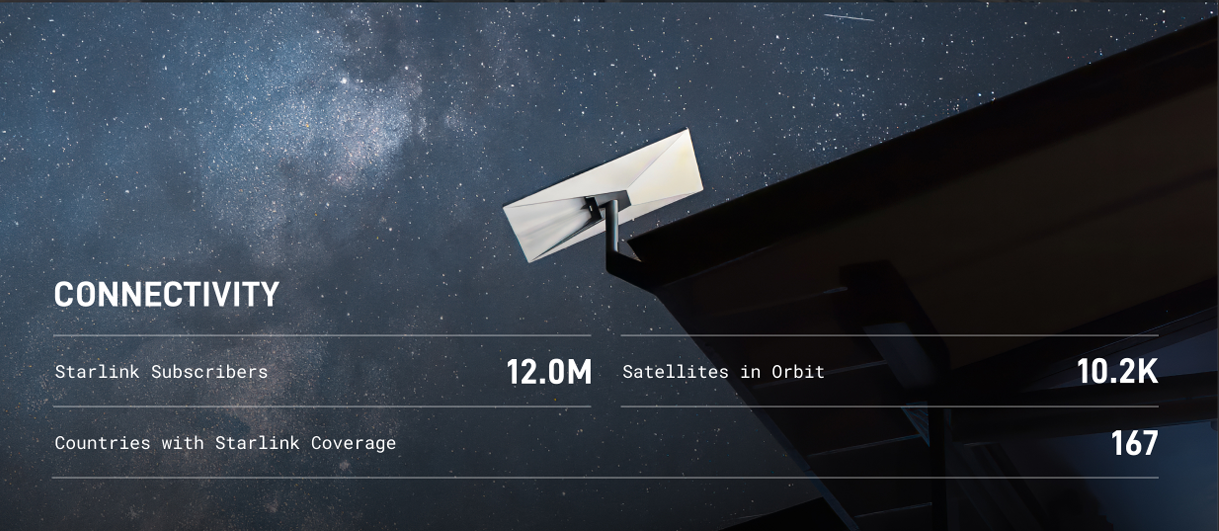
Starlink ended the quarter at 12.0m subscribers, double the 6.0m a year ago and up 1.7m sequentially. Reported ARPU held at $66 versus $66 in Q1 — but is down from $85 a year ago, a 22% decline.
The ARPU line deserves more attention than it got. Consumer revenue grew 44% y/y while the subscriber base grew 100%. Revenue per subscriber is therefore compressing at roughly the rate the base is internationalising. That is not a pricing failure; it is deliberate geographic mix as Starlink adds subscribers in 167 countries where $120/month is not a viable price point. But it means the consumer business is a volume story with a declining unit economic, and it makes the enterprise pivot strategically essential rather than merely attractive.
Which is exactly what management said. Enterprise & government revenue grew 108% y/y and 63% sequentially. Shotwell noted the company has never lost an enterprise customer and that Starlink remains under 10% penetrated in aviation. Musk went further, saying he expects enterprise revenue to eventually "substantially exceed" consumer.
One caution the release buries: Connectivity's adjusted EBITDA margin was 60.5% this quarter versus 61.2% a year ago. Despite doubling the subscriber base, the segment's EBITDA margin did not expand. Costs rose $970m y/y on constellation spend, V3 satellite R&D and marketing. The operating margin improved (38.6% vs. 35.7%) because D&A grew slightly slower than revenue — but the underlying cash margin is flat. Scale is not yet lowering the cost of a subscriber.
AI
$15.83bn of capex against $2.56bn of segment revenue. Compute went from 0.4GW a year ago to 1.0GW in Q1 to 1.4GW at quarter-end, with Colossus II building out.
The commercial story is genuinely strong: $14.1bn of Cloud Services Agreements signed, of which $1.6bn already converted to revenue inside the quarter — an unusually fast recognition profile that suggests these are capacity-delivery contracts rather than multi-year options. Management identified Google and Anthropic as recently closed CSA counterparties that begin ramping in Q4.
The financial story is unresolved. Advertising revenue — the legacy X business — was $367m, down from $426m a year ago and essentially flat sequentially. Strip it out and the AI segment is a pure infrastructure business generating $2.19bn a quarter on 1.4GW, i.e. roughly $6–8bn of annualised revenue per gigawatt depending on how you average the in-quarter capacity ramp. Hold that number; it is the one that determines whether the compute build ever earns its cost of capital.
Space
Space revenue of $962m grew 29% y/y on lower launch volume — a mix effect from larger customer payloads. R&D of $1,076m exceeded revenue. The segment lost $205m at the adjusted EBITDA line.
Nobody owns SPCX for the Space P&L. They own it for what Starship does to the marginal cost of the other two segments: satellite deployment cost for Connectivity, and eventually orbital compute economics for AI. Management's claim that Starship reduces cost to orbit by "99% or more relative to the historical average" is the load-bearing assumption underneath every long-dated valuation on this stock.
Future guidance: what management actually committed to
SpaceX did not publish formal guidance. It made verbal commitments on the call, which is a materially different thing and worth cataloguing precisely.
The $100bn ARR math, stated plainly
Q2 revenue of $7.81bn annualises to $31.3bn. Reaching a $100bn annualised run-rate by December implies a December exit month of roughly $8.3bn — versus an average of about $2.6bn per month in Q2. That is a 3.2× step-up in six months.
Management's bridge is the Cloud Services Agreements ramping in Q4, and Musk's framing was that the target is essentially reached even if the company "did nothing." Those two statements are in tension: if the target requires Q4 CSA ramps that have not yet begun, it is a contracted-revenue target, not an inertial one.
This is the number to hold management to. It is falsifiable within two quarters, and it is the difference between a company growing 92% and a company growing 300%. Our working assumption is that "annualised run-rate" here is being measured on an exit-month or exit-quarter basis inclusive of contracted compute deliveries — which is legitimate, but is not the same as $100bn of 2027 revenue.
Q&A analysis: what was asked, what was answered, and what was not
Questions came from Goldman Sachs (Eric Sheridan), Morgan Stanley (Adam Jonas), Citigroup, BofA (Ronald Epstein), JPMorgan (Douglas Anmuth), Deutsche Bank, UBS (John Hodulik) and Evercore ISI. That is an internet analyst, an autos/mobility analyst, an aerospace & defense analyst and a telecom analyst all covering the same ticker. No single sector framework currently prices this company, which is itself a source of multiple volatility.
The three best exchanges
Asked about line of sight to power, chips and permitting, Musk raised the target from 10GW by end-2027 to ~15GW by end-2027 with a 20GW stretch, and confirmed an exclusive Nvidia relationship. He framed SpaceX's edge as applying rocket-grade hardware engineering to terrestrial data centres.
The interesting sub-point was the supply constraint he volunteered: compute demand growing ~200% a year against memory supply growing ~20%. He offered that as support for premium pricing. It cuts both ways — it also caps how fast SpaceX can deploy the capex it is guiding to.
CFO Bret Johnsen's answer was the most consequential of the call: capex stays near $18.4bn for two more quarters, but AI compute capital has a sub-one-year payback and should be thought of "almost like a COGS item."
That reframing is doing enormous work. If true, the capex is not really capex and the FCF deficit is a timing artefact. If it is not true — if utilisation disappoints, or pricing normalises as memory supply catches up — then SpaceX is depreciating a $60bn+ asset base against revenue that has not yet arrived. Nothing else on the call matters as much as whether that payback claim survives contact with 2027.
Shotwell's "never lost an enterprise customer" plus "less than 10% penetrated in aviation," combined with Musk's expectation that enterprise exceeds consumer, is the clearest articulation yet of a deliberate shift away from the ARPU-diluting consumer base. For anyone modelling Starlink, this is the mix assumption to change.
The non-answers
Three things were asked and not answered, and each is material.
Asked about the $60bn acquisition as the call wound down, Musk declined to engage beyond saying the company is trying to close as quickly as possible. For a transaction equal to roughly 4% of market capitalisation and roughly 8× the company's trailing twelve-month revenue, that is a conspicuous silence. Strategic rationale, consideration mix, and any revenue or margin contribution remain undisclosed.
Shotwell explicitly declined to size it, citing "great and new ideas" that would be capital efficient. Investors are being asked to underwrite a new nationwide network on an assertion.
No FCF framework, no trajectory, no crossover date. In a quarter where the FCF deficit was the story, the absence is a choice.
What this earnings report means for the telecom market
This is the section telecom investors should read twice, because the most important disclosure of the quarter was not in the press release. It was a sentence on the call.
"The spectrum that we purchased from EchoStar does have terrestrial components, so we definitely intend to build out terrestrial."
She added that the company will build the infrastructure needed to make Starlink "a true mobile service," and expects to win "quite a few" customers from the big three US carriers. Musk added that the buildout would use small Starlink-based femtocells deployed on existing dishes rather than conventional macro base stations.
Verizon, AT&T and T-Mobile fell between 1% and 2.4% in pre-market trading the following morning.
Why this is a genuine strategic escalation
Until now, Starlink's direct-to-cell business was complementary: a coverage layer sold through T-Mobile's T-Satellite, filling dead zones the terrestrial network could not economically reach. Shotwell's comment reframes it as substitutive. SpaceX is describing itself as a prospective facilities-based mobile network operator.
The assets it has assembled make that credible rather than fanciful:
- Spectrum — 65MHz of nationwide licences acquired from EchoStar for approximately $19.6bn across two transactions, with FCC approval for the license transfer confirmed this quarter, under tech-neutral terms permitting satellite, terrestrial or hybrid deployment.
- Orbital capacity — 10.2k satellites in orbit, 167 countries, and a launch cost structure nobody can match.
- Distribution — 12m existing subscriber relationships, plus mobile partnerships with SoftBank, NTT Docomo and Spark NZ, and aviation deals with American, Southwest, Virgin Atlantic, Iberia and Aer Lingus.
- A next-generation mobile satellite launching next year that Shotwell characterised as "100× better" than today's service.
- A stated TAM anchor — she explicitly compared the opportunity to the roughly $600bn of annual revenue generated by the top three US carriers.
Why the sell-side telecom desks are unconvinced
The pushback was immediate and technical.
- Craig Moffett (MoffettNathanson) — without an MVNO agreement from an incumbent to provide baseline coverage, it is extraordinarily challenging to imagine a Starlink direct-to-consumer service competitive with carrier offerings inside five years.
- David Barden (New Street Research) — it makes no sense to try to replicate with 65MHz what terrestrial players built over 30 years with roughly 1,000MHz between them.
- Matt Britzman (Hargreaves Lansdown) — acquisition, of a smaller operator or of spectrum, sites and customers, looks like the fastest route, since incumbents are unlikely to wholesale capacity to an emerging competitor.
- The counter-view, David Wagner (Aptus Capital) — the market is underpricing the disruption because it is anchored on how incumbents build networks rather than on how SpaceX does.
Our framework: three battlegrounds, three verdicts
12m subscribers, 167 countries, and V3 satellites arriving with roughly 10× the capability of V2. Rural DSL, fixed wireless in low-density geographies and legacy GEO satellite (Viasat, Hughes) are being structurally displaced. Read-through is negative for rural ILECs and for the economics of the last tranche of subsidised rural fibre.
T-Mobile is aligned with Starlink; AT&T and Verizon are aligned with AST SpaceMobile, whose architecture bets on very large phased arrays — roughly 35–40× the antenna area per satellite — to deliver true broadband to unmodified handsets from far fewer spacecraft. AST's constraint is deployment speed and the fact that it does not own launch. Starlink's constraint is per-satellite link budget. The May 2026 tripartite D2D "joint venture" announced by the big three had no name, no spectrum allocation, no governance and no capital commitment — an alarm signal rather than a strategy.
Barden's spectrum arithmetic is correct on its own terms: 65MHz cannot carry urban capacity load. But that misreads the target. SpaceX does not need urban capacity parity to be disruptive. It needs a differentiated coverage proposition — no dead zones, anywhere, one account covering home and handset — sold to the segments where incumbents are weakest: rural consumers, aviation, maritime, logistics fleets, government, and enterprise resilience. Musk's femtocell-on-existing-dishes concept is a capex-light way to add urban capacity incrementally where the subscriber already is, rather than building coverage from zero. That is a genuinely novel network topology and it deserves modelling rather than dismissal.
The practical telecom read-through
- Timeline — next-gen mobile satellites launch in 2027; ~1,000 V3 broadband satellites for the material service step-change around Q2 2027. The competitive impact lands in 2027–2028, not 2026. Carrier estimates for the next four quarters do not need to change.
- Terminal value does need to change. The risk is not to next year's ARPU. It is to the assumption that mobile network economics remain a stable oligopoly with 30-year moats through 2035.
- T-Mobile holds the best near-term hand and the worst long-term one: it monetises Starlink today via T-Satellite and is the incumbent most exposed if Starlink goes retail.
- AT&T and Verizon are structurally short optionality here and dependent on AST executing a harder manufacturing problem without owning launch.
- Tower REITs (American Tower, Crown Castle) face a slow-burn narrative risk if a satellite-plus-femtocell topology gains credibility, well before any measurable lease impact.
- EchoStar has converted a wasting spectrum position into ~$19.6bn of cash and an ongoing MVNO relationship — the clearest winner in the value chain and the reason its shares traded up.
- Enterprise buyers should treat D2D as a coverage and resilience layer commercialising in phases, and should be renegotiating multi-year connectivity contracts now, while there are three credible bidders instead of one.
Hurdles: the risk register
−$25.0bn in the first half. Two more quarters at $18.4bn of capex implies roughly $65bn of FY26 capex against a revenue base that annualises near $31bn today. The $100bn cash pile funds roughly two more years at this burn without new financing. That is adequate, not comfortable.
PP&E net rose from $42.6bn to $65.7bn in six months. First-half D&A was already $5.29bn. Compute assets depreciate on short schedules. As 2026's capex converts to depreciation, incremental annual D&A of $10bn+ is plausible — which pushes GAAP profitability materially further out even if adjusted EBITDA compounds exactly as management hopes. Adjusted EBITDA is a poor primary metric for a company running capex at 2.4× revenue, and the gap between the two is going to widen before it narrows.
Roughly 911.5m shares — approximately $123bn at IPO pricing, larger than the existing tradable float — became eligible on 6 August, with further releases in December 2026 and June 2027. A secondary tranche of 455.8m shares triggers only if SPCX holds above $175.50 for five of ten sessions, which is currently remote. Piper Sandler's framing — that the overhang remains a valuation headwind into summer 2027 — is the right way to think about it. Near-term price action is a supply question, not a fundamentals question.
$13.3bn of the $39.4bn debt stack is related-party, generating $327m of related-party interest expense in the quarter alone. Combined with the xAI/X consolidation history, the Tesla investment that converted into SpaceX stock, and a $60bn Cursor acquisition the CEO declined to discuss, the governance discount is earned rather than imposed.
The named CSA counterparties — Google and Anthropic — are simultaneously customers, competitors and, in the broader AI infrastructure economy, counterparties to each other. $14.1bn of contracted sales concentrated in a small number of hyperscale and frontier-lab buyers is a different risk profile from 12m consumer broadband subscriptions.
Musk's own framing — 200% demand growth against 20% memory supply growth — is a constraint on the 15GW target as much as a tailwind for pricing.
Going from 1.4GW to 15GW in eighteen months requires interconnection, generation and local approvals that do not respond to engineering velocity.
The near-term binary is the Flight 14 tower catch, tentatively end-August. Musk declared the heat shield problem "solved" after Flight 13. The daily-cadence target within a year is the single most aggressive operational commitment made on the call.
Cursor requires antitrust clearance. Spectrum carries performance obligations. International market access for Starlink is a country-by-country negotiation, and geographic expansion is explicitly expected to dilute blended ARPU further.
Across an unusually wide set of simultaneous frontier programmes.
Where the company is, and where it is heading
A connectivity company with a launch business attached and an AI infrastructure business bolted on, currently valued around $1.5trn. Connectivity generates all of the group's positive cash flow. Space is a funded R&D programme whose output — cheap mass to orbit — is the input to everything else. AI is a capital-intensive land grab that has just started to produce revenue and has not yet produced returns.
A $100bn revenue run-rate by December, a $1trn revenue business by 2030, 15GW of compute by end-2027, daily Starship flights within a year, boots on the moon in 2028, and a mobile network that takes share from the incumbent carriers.
The gap between those two paragraphs is the investment case.
Three scenarios
The sub-one-year AI payback holds. CSA revenue ramps in Q4 as promised and the $100bn run-rate is approximately met. Starship catches the ship on Flight 14 and moves toward high cadence, collapsing the deployment cost of V3 broadband satellites and the mobile constellation. Enterprise connectivity mix drives Starlink revenue growth ahead of subscriber growth, reversing ARPU dilution. Capex intensity peaks in 2027 and the D&A wave is absorbed by a business already generating $100bn+. In this world the current price is a lockup-induced discount on a company that owns the launch, connectivity and inference layers simultaneously — the framing behind Morgan Stanley's $300 target.
Revenue compounds at a very high rate but the $100bn December run-rate slips a quarter or two. AI capex stays elevated through 2027, FCF remains deeply negative into 2028, and adjusted EBITDA growth is repeatedly offset by depreciation at the GAAP line. Starlink keeps adding 1.5–2m subscribers a quarter with flat-to-down ARPU while enterprise mix improves the revenue quality. The telecom disruption is real but arrives in 2028 rather than 2027. The stock trades on supply dynamics and capex headlines for four quarters. Analyst targets remain dispersed across the roughly $50–$300 range currently visible — dispersion that is itself the honest signal.
Compute pricing normalises as memory supply catches up, the payback claim stretches from under a year to three, and utilisation on 15GW disappoints. The depreciation wave lands on a revenue base that grew 150% rather than 300%. GAAP losses widen rather than narrow through 2027. Lockup supply through June 2027 caps any re-rating. Cursor closes and adds $60bn of goodwill to a balance sheet that has to fund it. In this scenario the terminal question becomes whether Connectivity's ~$5bn/year of self-funded cash generation can support a $1.5trn valuation on its own — and it cannot.
What we are watching into Q3
Frequently asked questions
What were SpaceX's Q2 2026 results?
Why did SPCX stock fall after beating estimates?
How many Starlink subscribers does SpaceX have?
What is SpaceX's revenue guidance?
Is Starlink going to compete with AT&T, Verizon and T-Mobile?
When does SpaceX become profitable?